
Last week, we started our study learning about Elohim. I also challenged you to find out the meaning of your name and find a verse that ties to the characteristic of your name.
At first, I jumped on John 3:16, but yesterday we were at the celebration of life service for a very special man and influence in my life. At the end of the service, they played a recording of him when he had given a message on 1 Corinthians 13. I heard the voice of a man that I admired and lived this verse well read out, “Love is patient, love is kind, love is not jealous or boastful or proud or rude. It does not demand its own way. It is not irritable, and it keeps no record of being wronged. It does not rejoice in injustice but rejoices whenever truth wins. Love never gives up, never loses faith, is always hopeful, and endures through every circumstance.”
This challenged me as my name, Amy, means “love” or “beloved.” I found myself questioning whether I do those things well.
Genesis 1:27 says that we are made in His image; He is our creator. Since God made us in his image, he has instilled in us creative power. What are your creative gifts?
I shared a link to find out what your spiritual gifts are.
1 Corinthians 12:7-11 says:
“A spiritual gift is given to each of us so we can help each other. To one person, the Spirit gives the ability to give wise advice; to another, the same Spirit gives a message of special knowledge. The same Spirit gives great faith to another, and to someone else the one Spirit gives the gift of healing. He gives one person the power to perform miracles and another the ability to prophesy. He gives someone else the ability to discern whether a message is from the Spirit of God or from another spirit. Still another person is given the ability to speak in unknown languages, while another is given the ability to interpret what is being said. It is the one and only Spirit who distributes all these gifts. He alone decides which gift each person should have.”
What are your gifts? Were you surprised by them? Do they challenge you?
My gifts are serving, teaching, and mercy giving.
“Acts of service” is my love language, so I wasn’t too surprised by that one. Mercy giving also wasn’t a surprise to me. Teaching, on the other hand, was a bit of a surprise. This one is a challenge to me. Obviously, I want to make sure everything I am teaching you all is truth and I want to inspire and encourage you all. But teaching is not my strength, at least not in my eyes.
What do you think it means to be created in the image of God?
Did you use the name of Elohim in your prayers this week? If so, how did it feel? Did you feel a stronger connection to God?
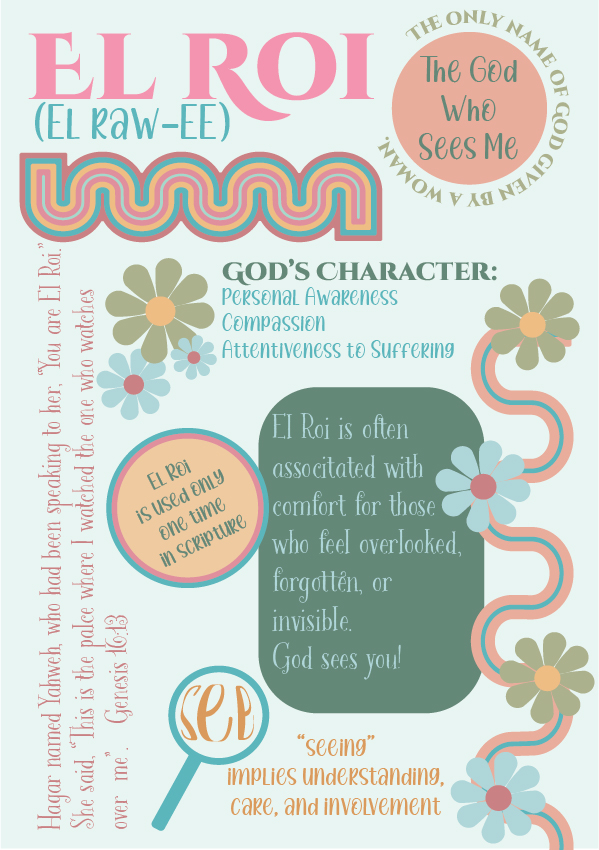
This week, we are studying the name El Roi. (Raw-EE) El Roi is the only name given to God by a woman. It appears in Genesis 16 in the story of Abram, Sarai, and Hagar. In this story, we see where Sarai gets desperate to have a child. She is barren at this point, and she knows the promise that God made to Abram, that he will be the father of many nations. Since she hasn’t been able to get pregnant, she decides to take matters into her own hands.
Hagar was an Egyptian maidservant. The assumption is that Hagar was one of the servants that Pharaoh gave to Abram in chapter 12. Her name, Hagar, is a Hebrew name that means “stranger” or “sojourner.” So it is probable that Abram or Sarai gave her the name, or it came from someone in his household.
The custom of the time was that if a woman could not get pregnant, she would offer her maidservant to her husband to sleep with. A servant was considered property, a possession that the wife could use when she wanted, how she wanted. And the fruits of the maid’s labor were considered those of the wife. So any child that Hagar had would belong to Sarai.
Now, after Hagar became pregnant, she started treating Sarai badly. Or perhaps Abram looked at her differently; we really aren’t sure. What we know is that Sarai was no longer happy with the arrangement that she instigated. So Sarai mistreated Hagar so badly that Hagar ran away.
While in the wilderness, Hagar was confronted by the Angel of the Lord. (16:7) He says, “Hagar, Sarai’s servant, where have you come from and where are you going?”
The language used here is important to note: “Hagar, Sarai’s servant,” as this shows that he knows who she is and to whom she belongs, that she was the “property” of another.
The angel listened to her and told her that she was with child and that she needed to go back to Abram and Sarai. He also told her that she would be given many descendants. She was to name this son Ishmael, which means “God hears”, Yish-“he heard,” and El, “God”—because God has heard her affliction and her cries of distress.
At this point, Hagar names Yahweh, “You are El Roi” (Raw-EE), “for this is the place where I watched the one who watches over me.”
Another translation says, “You are the God who sees me.”
This is why the well is named Beer Lahai Roi (Raw-EE) (Well of the Living One Who Watches Over Me).
As a woman, there have been times in my life when I have felt overlooked or unseen, so the significance of this name is not lost on me. This is why it is one of my favorite names of God. As much as I love to be a fly on the wall or work in the background, it is nice to be noticed and appreciated, especially by the ones you love.
As we go into this week, learning about the one who watches over us, I want you to think about
- Like Hagar, is there a time in your life when you have felt “unseen”?
- El Roi (Raw-EE) doesn’t just see the physical us, but also our thoughts, emotions, and inner self. What part of you do you need El Roi to see right now?
- How does it make you feel knowing that God sees you? The past, present, and future you.
As we walk into this week, I hope you bask in the light of knowing that God sees you.
Have a great day with Jesus!

 Life on E Street