
Last week, we studied El Olam, the everlasting God or Eternal God.
Abraham gave God this name after Isaac was born and after he made a treaty with Abimelech and Phicol. Abraham knew that our God’s promises were everlasting, they are eternal, and he saw the beginning of God’s promise being fulfilled through Isaac.
Our everlasting God has no beginning and no end.
What do you think of when you think of everlasting?
I know it can be hard to comprehend in our human minds, but I think of the ocean. Yes, I know it has a beginning and an end, but if you are standing on the beach, you cannot see how far it goes, and the waves do not stop.
How does God’s eternal nature relate to His promises?
We learned this week that El Olam transcends generations. So his promise to Abraham didn’t just end with Abraham; it went to his descendants.
One of the verses that has the name El Olam in it is one that I love. Isaiah 40:28-29.
Don’t you know? Haven’t you heard? El Olam, Yahweh, the Creator of the ends of the earth, doesn’t grow tired or become weary. His understanding is beyond reach. He gives strength to those who grow tired and increases the strength of those who are weak.
What characteristics about God do you see in this verse?
I love that this verse highlights that God never rests.
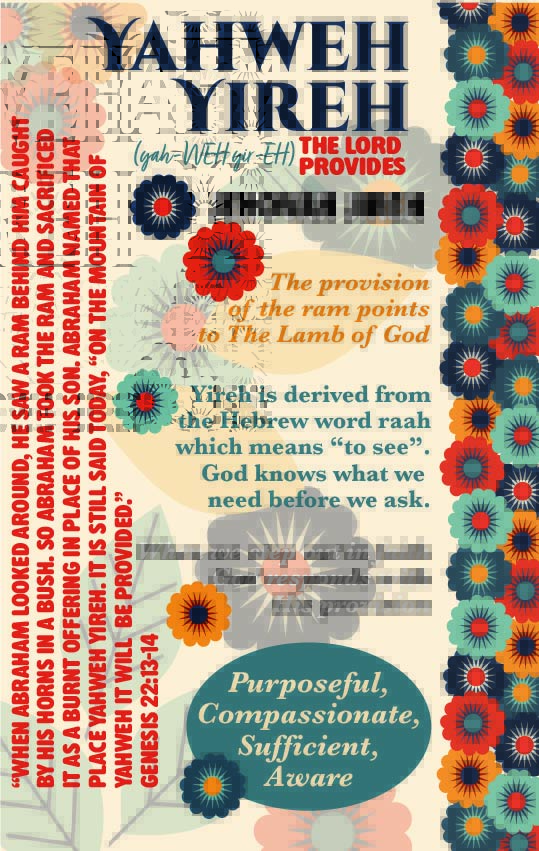
This week we will be studying Yahweh Yireh, or Jehovah Jireh, which means “The Lord Will Provide.”
El Olam gives us hope. Yahweh Yireh gives us provisions.
This name is mentioned one time in scripture, again by Abraham, in Genesis 22:13-14
Has anyone noticed how many names we have studied so far that are related to Abraham?
El Olam was given to us approximately 3-5 years after Isaac was born. Now here we are with Abraham and Isaac about to go up a mountain where God has asked Abraham to sacrifice his son. Isaac was probably in his twenties at this point. Old enough to know what was going on. He is not the child that we see in our Bible storybooks.
Starting in Genesis 22, in the story, you will notice that Abraham didn’t question God. He didn’t waver in responding. In fact, when God called out to him, Abraham said, “Here I am.”
God first called himself El Shadday to Abraham; Abraham named him El Olam in our study last week. Now our Almighty Everlasting God is testing Abraham by asking him to take his promised son, the one that all the many descendants will come, and sacrifice him.
Just want to pause for a moment and think on this. Abraham didn’t question God, but do you think Sarah did? Do you wonder if Abraham even told her?
We know from what we have studied so far that Abraham and Sarah both have a tendency to take matters into their own hands, and now they are blindly following God’s request to offer their son as a sacrifice, no questions asked. We can see from just the names of God and where they are found in scripture just how much Abraham’s faith has grown in a few short chapters. It has taken several years, but look at how he has grown in his faith. I don’t know about you, but that gives me encouragement.
So God tells Abraham to go and take your son and sacrifice him. Early the next morning, Abraham takes Isaac and loads up the donkey with enough wood for a burnt offering and two servants, and they set off. On the third day Abraham saw the place that God told him about in the distance.
This was not a quick journey. It was approximately 50-60 miles to Mt. Moriah. Abraham has known the plan for three days now and what he was about to do. He hasn’t mentioned to anyone what is about to happen. He has walked this route with the weight of knowing that he is about to offer his son as a sacrifice. I can’t imagine he had a pep in his step or was in a hurry to get to the place of sacrifice. Granted it was mountainous terrain, with a loaded down donkey, two servants, and Isaac, but still, there was an added weight in this journey.
If it were me, I would be stating facts in my head. God doesn’t like human sacrifices. God said that this is the son that his promises would be fulfilled. God knows I love him. If I do kill my son in obedience, then surely El Shadday will raise him from the dead….
But there is no mention of Abraham’s inner monologue or any conversation on the trip.
When Abraham sees the place where they are going, he loads up Isaac with the wood, and then he carries the fire and the knife. This is where Isaac notices that they are missing the lamb and asks Abraham, “Where is the lamb for the burnt offering?”
Abraham replies, “The Lord will provide.”
I know my 20-year-old son would not have accepted that answer without a lot of follow-up questions, but it is apparent that Isaac is leaning in to Abraham’s confidence in God’s provision. This tells me that the faith of Abraham has grown to the point that Isaac knows that he can trust his father, Abraham, as Abraham is trusting God.
Now, the way this story is told, I feel like we are missing out on so much. Abraham builds the altar, ties up Isaac, and lays him on it. No questions from either party, just quiet obedience. Isaac is big enough that he could probably land a solid punch on Abraham and run away, but he doesn’t. He just obeys.
We know that Abraham believes in the promise that El Shadday gave him that he would be the father of many nations, and we know that Abraham knows that that will be through Isaac. Hebrews 11 tells us that (vs. 17) “by faith Abraham, when God tested him, offered Isaac as a sacrifice. He who had embraced the promises was about to sacrifice his one and only son, even though God had said to him, “It is through Isaac that your offspring will be reckoned. Abraham reasoned that God could even raise the dead, and so in a manner of speaking, he did receive Isaac back from the dead.”
With that assurance, Abraham raised the knife to kill his son; the angel of the LORD stopped him and said, “I know that you fear God, because you have not withheld from me your son, your only son.”
This is when Abraham looks up and sees the ram.
It is after the ram has been sacrificed that Abraham names the place Yahweh Yireh/The Lord Will Provide.
We have watched Abraham grow in our studies. We have seen how he has questioned God. How Sarah laughed at becoming a mom at 99. We have seen how both Abraham and Sarah have not waited on God but taken matters into their own hands and made a mess of things. And now we see Abraham take a huge step of faith and willful obedience in God’s testing of his faith.
How often, when we are tested, do we jump to complain? Do we try to solve things on our own? Is there a time when you can say, “I was tested, and I waited for God”?
God’s provision is given when we trust. His provision is never late. It is always on time.
It is in the times of testing that we grow in our character and in who God is calling us to be.
What is it that you need God to provide for you?
Is there a time when you have seen God show up? Can anyone share?
This week, I want you to consider a future worry you have. Maybe it’s who your children will marry, if they will ever potty train, or maybe it’s something God has asked you to do, but you’re unsure of what that looks like or how it will happen. Then I want you to consider your past. How has God provided for you in the past or in the present?
Once you consider that, how can the God of your past provision not show up for your future ones?
His faithfulness will always prevail. Our God, who has always been, will always provide.
Have a great day with Jesus!

 Life on E Street