
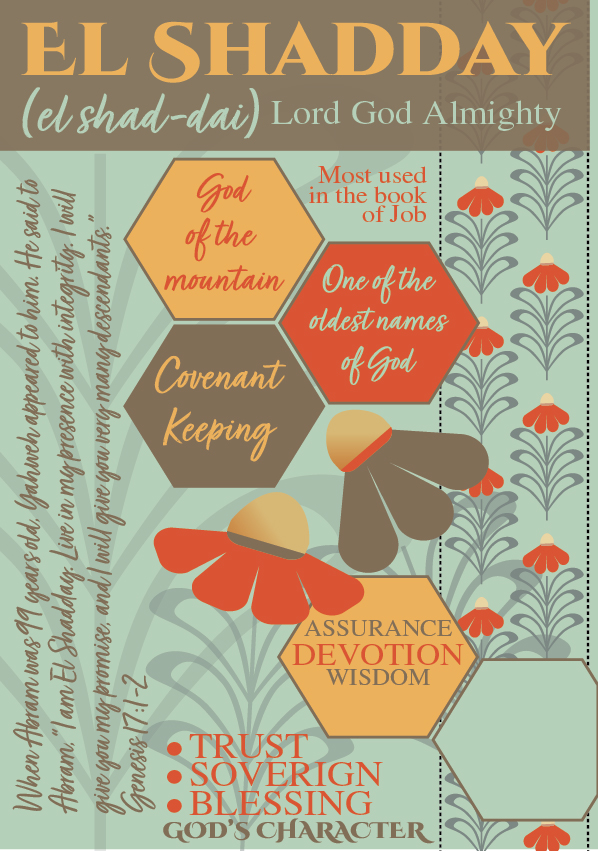
Last week, our focus was El Shadday, God Almighty. God gave himself this name in Genesis 17:1, where he told Abraham, “I am El Shaddai. Live in my presence with integrity.” This name is associated with our covenantal God, as he called himself that before giving Abraham the promise that he would make him the “father of many nations.”
Why do you think that God linked this particular name to covenants and promises?
What does the name El Shaddai mean to you? How have you seen him work in your life?
El Shaddai’s literal translation is “the Mountain One”. We talked last week about what we thought of when we saw a mountain. How did El Shaddai reveal himself to you this week? Did anyone have a “mountain” moment?
When we pray using the name El Shaddai, we pray to invoke his power, his promise, and his blessing. Did you use his name in prayer this week? How did it make you feel?
We have a personal situation going on that I prayed for his blessing upon, and I got a definitive answer.
In the deeper study section, we were asked to consider the name El Shaddai and how it relates to the context of passages.
Who is El Shaddai in Genesis 28:3?
Ruth 1:20-22
Job 6:1-4, 13-14
Who looked up the story of Balaam (Numbers 22-24)? What did you think?
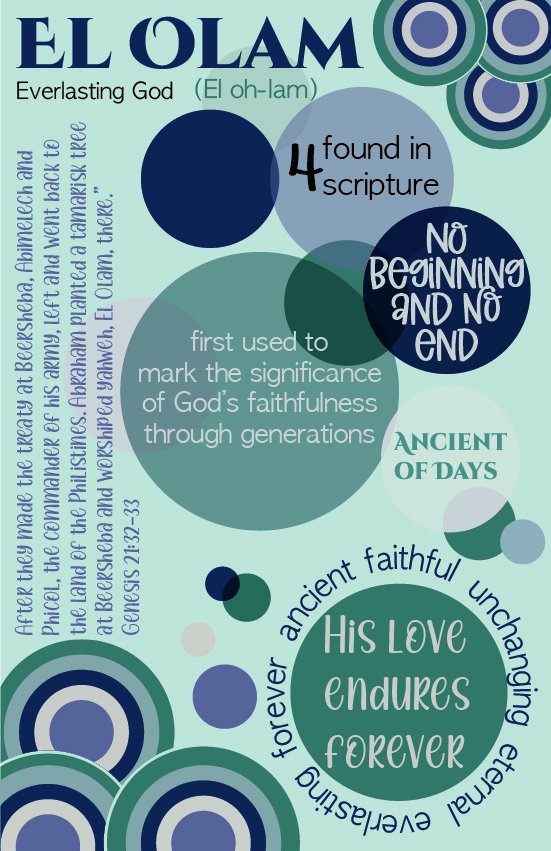
This week we will be studying the name El Olam. The everlasting God or the Eternal One. Where El Shaddai meets us in our waiting, El Olam will give us hope.
Our key scripture is Genesis 21:32-33
“After they made the treaty in Beersheba, Abimelech and Phicol, the commander of his army, left and went back to the land of the Philistines. Abraham planted a tamarisk tree at Beersheba and worshipped Yahweh, El Olam, there.”
A little context as to what is going on here. If we back up to Genesis 20, we will see that Abraham and Sarah are new to the town of Gerar. Abraham was pulling the same stunt he did in Genesis 12 when they were in Egypt, and he introduced her as his sister. Which, technically, she was; she was his half-sister.
King Abimelech sent for her and had her brought to his palace in an effort to make her his new wife.
The name Abimelech is a title, like Pharaoh, for king or ruler. Phicol (fi-coal) was a name used for a commander, like a general.
According to Genesis 20:3, God spoke to Abimelech in a dream. This tells us that Abimelech was a God-fearing man. God had told him that he was a dead man because Sarah was already married. Abimelech said whoa! I haven’t touched her, and I was told she was his sister. I didn’t know. I’m innocent. God said, yes, that is why I am coming to you so that you stay that way. Return her to her husband, and he will pray for you, and if you don’t, then you will surely die.
Early the next morning, Abimelech gathered his people and told them what happened. He summoned Abraham and said, why did you do this? What have I done to you to possess you to do such a thing?
Abraham said, in my defense, I thought this was a godless place, and “technically,” she is my sister. Insert shoulder shrug.
Abimelech gave him cattle, male and female servants, and gave him back his wife, Sarah, and 1,000 pieces of silver, and said, choose where you want to live. I am settling any claims against me, and your reputation is clear.
Abraham prayed, Abimelech was spared certain death, and the women of his home were blessed to be able to have children. Since this was mentioned, this tells us that Sarah was living in the house long enough for the women to realize that they weren’t getting pregnant.
Then we move to chapter 21, where we are now seeing the covenant of God that was made in chapter 17 starts to come to fruition. Isaac is born.
In verse 22, Abimelech and Phicol come to visit Abraham. At least five years have passed at this point since Abraham first came to settle in Gerar. Abimelech sees that God is blessing Abraham and asks him to “swear that you will never deceive me, my children, or descendants.”
Abraham swears and then lodges a complaint against some of Abimelech’s servants who have taken a well from Abraham’s servants by force. Abimelech says he doesn’t know anything about it. Abraham gathers some animals to give to Abimelech, and they make a treaty. Then Abraham gathered seven lambs and gave them to Abimelech to show the agreement that Abraham dug a well, which he named Beersheba (well of the oath).
After they left, Abraham planted a tree, and there he worshiped the LORD, the Eternal God- El Olam.
Now that we know a little more context on this verse lets talk about the name. El Olam.
El Olam is used four times in scripture and means everlasting God and is applied to his laws, promises, covenant, and kingdom.
What do you think of when you think of everlasting?
God has no beginning and no end. That is something that is hard for our human minds to comprehend because we have a beginning and an end.
John 1 says, “In the beginning the Word already existed. The Word was with God, and the Word was God.”
Deuteronomy 33:27 says, “The eternal God is your refuge, and his everlasting arms are under you.”
Jeremiah 10:10 says, “But the LORD is the only true God. He is the living God and the everlasting King!”
In Isaiah 9, when he prophesied of the coming Christ, he said his name will be called, Wonderful Counselor, Mighty God, Everlasting Father (EL Olam), and Prince of Peace.
El Olam is our constant. He is always there, always was, and always will be. He is our hope when things look bleak. He is with us on our mountain top and in our valleys.
As we go into this week, let’s think about how El Olam’s eternal nature relates to his promises.
Where have you seen the hope of El Olam in your life already?
Is there something in your life now that you need to surrender to our everlasting Father?
Have a great day with Jesus!
 )
)
 Life on E Street